Generated: 2026-05-02
Packet folder: `C:\Users\Tony\Documents\GitHub\ocarina`
| File | Purpose |
|---|---|
| `design.md` | Project intent, catalog metadata, assumptions, and validation plan. |
| `bom.csv` | Starter bill of materials with part categories, quantities, drawing refs, and notes. |
| `sourcing.csv` | Supplier/search tracker with specs, price/date fields, lead time, substitutes, and risks. |
| `cut-list.csv` | Rough/final stock sizes, material, grain/orientation, operations, yield, and offcuts. |
| `drawing-brief.md` | Manufacturing drawing and technical product sketch brief. |
| `assembly-manual.md` | Shop-facing sequence, tools, fixtures, safety, tuning, finishing, and maintenance notes. |
| `validation.csv` | Target/measured values, tolerance, environment, result, and tuning/build action log. |
| `supplier-rfq.md` | Supplier email/request-for-quote starter. |
| `visual-bom-brief.md` | Art direction for an image-forward visual BOM. |
| `wolfram-starter.wl` | Wolfram starter for physics, optimization, visualization, and validation. |
| `README.md` | Project artifact. |
Project intent, catalog metadata, assumptions, and validation plan.
Build a slip-cast ceramic Alto C 12-hole ocarina using a 3D-printed master and plaster mold workflow. The current table is focused on the standard "sweet potato" vessel-flute form, but the same model can be used as the baseline for sculptural vessel flutes.
Ocarinas behave primarily as Helmholtz resonators:
f = c/(2*pi) * sqrt(A_open/(V_chamber * L_eff))
Unlike a transverse flute or Native American style flute, pitch is driven by chamber volume and total open-hole area, not tone-hole distance along a bore. Hole position is still important for ergonomics, grip, and fingering logic.
| Field | Current value |
|---|---|
| Ocarina type | Alto C, 12-hole |
| Chamber volume | 130 cm3 |
| Wall thickness | 0.4 cm |
| Voicing window width | 0.9 cm |
| Voicing window height | 0.5 cm |
| Speed of sound | 34300 cm/s |
| Clay body | Cone 6 stoneware |
| Shrinkage | 12 percent |
| Target low note | A4, 440 Hz |
| Target high note | F6, 1397 Hz |
During inspection, rows 39-42 of the 12-hole fingering chart contain formulas for hole area, cumulative open area, and calculated frequency. Rows 43-51 currently show placeholder `=` cells instead of filled formulas. Recommended next workbook cleanup:
1. Copy the area formula pattern from `D40:D42` through `D51`.
2. Copy the cumulative area pattern from `E40:E42` through `E51`.
3. Copy the frequency formula pattern from `F40:F42` through `F51`.
4. Add measured frequency, cents error, and tuning action columns.
5. Add a note that hole combinations can be cross-fingered if total open area is equivalent.
6. Verify the size-library `Length (in)` column. Inspection showed serial-like values such as `46180`, so those cells may have been formatted or entered incorrectly.
Use a 2-piece plaster mold for the main body. The first prototype can use a press-molded body to speed iteration, but production should move toward slip casting once the fipple and chamber volume are stable.
Recommended mold/CAD features:
| Prototype | Goal | Success criteria |
|---|---|---|
| OCA-P0 voicing tile | Practice windway/labium only | Clear tone on a disposable test cavity |
| OCA-P1 closed vessel | Verify chamber volume and fipple | Stable A4-ish all-closed tone before finger holes |
| OCA-P2 4-hole | Prove tuning workflow | Four tuned notes within +/-25 cents after bisque |
| OCA-P3 12-hole | Full range test | Chromatic pattern playable, no blocked grip |
| OCA-P4 matched set | Soprano C, Alto C, Bass C | Shared mold logic and glaze family |
Starter bill of materials with part categories, quantities, drawing refs, and notes.
| item_id | category | item | qty | spec | make_buy | estimated_cost | source_note | drawing_ref | notes |
|---|---|---|---|---|---|---|---|---|---|
| OCA-BOM-001 | Master | 3D printed body master | 1 set | PLA or resin printed top and bottom master | Make | $2-5 | Workbook estimate not date-checked | OCA-DRW-001 | Scale master for measured clay shrinkage. |
| OCA-BOM-002 | Mold | #1 pottery plaster | 10 lb | USG #1 pottery plaster or equivalent | Buy | $15-25 | Workbook estimate not date-checked | OCA-DRW-002 | Enough for several small mold sets depending on cottle size. |
| OCA-BOM-003 | Clay | Cone 6 stoneware slip or clay body | 25 lb | Slip casting body or press-moldable clay | Buy | $20-35 | Workbook estimate not date-checked | OCA-DRW-003 | Record batch and measured shrinkage. |
| OCA-BOM-004 | Finish | Cone 6 exterior glaze | 3-5 pints | Food-safe or durable ceramic glaze | Buy | $30-60 | Workbook estimate not date-checked | OCA-DRW-004 | Mask fipple, holes, and interior. |
| OCA-BOM-005 | Tuning | Diamond needle files | 1 set | Assorted profiles | Buy | $10-20 | Workbook estimate not date-checked | OCA-DRW-005 | Needed after bisque and final fire. |
| OCA-BOM-006 | Tuning | Chromatic tuner or analysis app | 1 | Cent-accurate tuner | Buy | $15-30 | Workbook estimate not date-checked | OCA-VAL-001 | Use same app/settings across prototypes. |
| OCA-BOM-007 | Mold | Mold soap or release | 1 bottle | Murphy's oil soap or mold release | Buy | $5-10 | Workbook estimate not date-checked | OCA-DRW-002 | For sealed master and plaster parting surfaces. |
| OCA-BOM-008 | Firing | Bisque and glaze firing | per load | Cone 06 bisque and Cone 6 glaze | Buy | $20-50/load | Workbook estimate not date-checked | OCA-VAL-002 | Record firing schedule and kiln location. |
| OCA-BOM-009 | Masking | Wax resist | 1 small jar | Brushable wax resist | Buy | TBD | Add supplier/date before purchase | OCA-DRW-004 | Protect tuning-critical holes and fipple. |
| OCA-BOM-010 | Measurement | Graduated syringe or burette | 1 | Water-fill volume measurement | Buy | TBD | Add supplier/date before purchase | OCA-VAL-003 | Needed for chamber volume validation. |
Supplier/search tracker with specs, price/date fields, lead time, substitutes, and risks.
| item_id | item | required_spec | search_terms | supplier_candidates | date_checked | unit_price | lead_time | substitution_rule | risk_note |
|---|---|---|---|---|---|---|---|---|---|
| OCA-SRC-001 | #1 pottery plaster | Pottery mold plaster suitable for absorbent ceramic molds | USG #1 pottery plaster 10 lb 25 lb | TBD | Use equivalent pottery plaster if absorption and strength are similar | Wrong plaster can give weak molds or poor casting absorption. | |||
| OCA-SRC-002 | Cone 6 casting slip | Stoneware slip with known shrinkage and firing schedule | cone 6 stoneware casting slip shrinkage | TBD | Substitute only after measuring shrinkage bars | Unknown shrinkage invalidates CAD scale factor. | |||
| OCA-SRC-003 | PLA or resin | Print material that can be sanded and sealed | PLA filament smooth master mold making resin print | TBD | Any stable printable material is acceptable if sealed | Layer lines transfer into mold and cast. | |||
| OCA-SRC-004 | Mold release | Mold soap compatible with plaster | pottery mold soap plaster release | TBD | Commercial mold soap preferred | Release failure can damage master or mold. | |||
| OCA-SRC-005 | Diamond files | Small round and tapered profiles | diamond needle file set ceramic tuning | TBD | Diamond burrs can substitute for some work | Coarse tools chip fired ceramic. | |||
| OCA-SRC-006 | Wax resist | Brushable wax for glaze masking | ceramic wax resist glaze masking | TBD | Latex or tape only if kiln-safe workflow is confirmed | Glaze in holes or windway can ruin tuning. | |||
| OCA-SRC-007 | Measurement tools | Cent-accurate tuner plus volume measurement | chromatic tuner cents water volume graduated syringe | TBD | Phone app acceptable for early tests | Inconsistent measurement hides process drift. |
Rough/final stock sizes, material, grain/orientation, operations, yield, and offcuts.
| cut_id | part | qty | rough_dimensions_in | final_dimensions_in | material | orientation | operation | tolerance_in | yield_or_offcut | notes |
|---|---|---|---|---|---|---|---|---|---|---|
| OCA-CUT-001 | Master body upper half (3D-printed) | 1 | 4.50 x 3.50 x 2.50 envelope | master scale = 1/(1-shrinkage); for 12% shrinkage = 1.136x fired body | PLA or sealable resin | X along mouthpiece axis; Z up; mark split-line and chamber datum | Print, sand layer lines, fill voids, seal/sand, sign with build ID | +/-0.010 | Save offcut sprues for shrinkage coupons | Master scale factor must be re-derived from MEASURED clay shrinkage before final master. |
| OCA-CUT-002 | Master body lower half (3D-printed) | 1 | 4.50 x 3.50 x 2.50 envelope | mirror of OCA-CUT-001 | PLA or sealable resin | X along mouthpiece axis; Z up; mark split-line | Print, sand, fill, seal | +/-0.010 | Reuse offcut sprues for shrinkage coupons | Same scale factor as OCA-CUT-001. |
| OCA-CUT-003 | Wooden cottle boards (mold making) | 4 | 8 x 6 x 0.75 each | 7.50 x 5.50 x 0.75 each | Melamine-faced MDF or sealed plywood | Smooth face inward; mark inner clamping zone | Cut, edge-seal, drill clamping holes | +/-0.030 | One sheet of 24 x 18 x 0.75 yields all 4 | Clean parting wax/release before each pour. |
| OCA-CUT-004 | Plaster mother mold half (poured) | 2 | 7.50 x 5.50 x 2.00 each | 7.50 x 5.50 x 1.50-1.75 each (around master) | USG #1 pottery plaster (or equiv.) | Pour with master keyed to first half; second half over registration | Mix to 73:100 water:plaster (by weight); 2-min slake; pour around sealed master | +/-0.060 | Trim spew/edge after demold; recover small offcuts as test slabs | Min 1.50 in plaster around master where practical for stiffness. |
| OCA-CUT-005 | Greenware vessel (slip-cast) | 1 per pour | ~3.95 x 3.07 x 2.20 (master cavity wet) | ~3.50 x 2.72 x 1.95 fired (12% shrink) | Cone 6 stoneware casting slip | Mouthpiece axis along master split | Slip pour > drain at target wall (~0.16 in / 0.4 cm) > demold leather-hard | N/A (process-controlled) | Reuse demold trim/fettling waste as slip recycle | Wall thickness drives drying time and tap tone — measure on noncritical trim. |
| OCA-CUT-006 | Voicing window cut (leather-hard) | 1 | N/A | 0.354 x 0.197 (window W x H = 0.9 x 0.5 cm per design) | Cone 6 greenware | Cut perpendicular to mouthpiece axis | Score, lift, clean labium edge with rib | +/-0.010 | N/A | Cut undersized; tune by enlarging at bisque tuning step. |
| OCA-CUT-007 | Finger holes (12-hole layout — leather-hard) | 12 | N/A | 0.16-0.31 dia each (start undersized; see design table OCA-DRW-005) | Cone 6 greenware | Per fingering chart row D40:F51 of design table | Brass tube cutter or hole punch; clean burr with damp finger | +/-0.010 (start) | N/A | All 12 holes start at design-table 'minimum' diameter; enlarge at tuning. |
| OCA-CUT-008 | Post-bisque tuning trim | as needed | N/A | Within +/-25 cents of target frequency per validation.csv | Bisqued ceramic | N/A | Diamond needle file or fine diamond burr in steps | +/-0.005 dimensional; +/-25 cents acoustic | Diamond burr offcuts are kiln dust — bag and discard | Document each enlarge step on validation row. |
| OCA-CUT-009 | Wax resist mask (pre-glaze) | 1 application | N/A | ~0.020 in dry film over voicing window + all 12 holes + interior | Brushable wax resist | N/A | Brush-apply; dry per supplier; check all openings clear | Visual | N/A | Mask all acoustic edges to keep glaze out of windway and holes. |
| OCA-CUT-010 | Glaze application (exterior only) | 1 application | N/A | ~0.005-0.010 in per coat; 1-2 coats exterior | Cone 6 satin or matte glaze | Avoid waxed regions | Dip / brush / spray exterior only | +/-0.005 (visual) | N/A | Glaze in voicing window or holes will detune the instrument. |
Manufacturing drawing and technical product sketch brief.
| Dimension | Source | Tolerance intent |
|---|---|---|
| Chamber volume | Workbook input and water-fill measurement | Tuning critical |
| Voicing window width/height | Workbook input | Playability critical |
| Windway gap | CAD/test-piece measurement | Playability critical |
| Labium angle and edge thickness | CAD/test-piece measurement | Playability critical |
| Wall thickness | Workbook input and cast measurement | Tone/drying critical |
| Hole diameters | Workbook chart and tuning log | Tuning critical |
| Master scale factor | Measured clay shrinkage | Process critical |
Shop-facing sequence, tools, fixtures, safety, tuning, finishing, and maintenance notes.
This manual covers a slip-cast or press-molded ceramic ocarina based on `docs/Ocarina.xlsx`. It is written for prototype builds where the first goal is repeatable tone and validated tuning, not decorative finish.
1. **Set design inputs**
- Confirm target ocarina size, chamber volume, voicing window, wall thickness, clay body, and shrinkage.
- Create a build ID before CAD begins.
2. **Model the master**
- Model the body as a controlled-volume vessel.
- Include split-line planning, registration features, and a fipple strategy.
- Scale the master by `1/(1 - measured_shrinkage)`.
3. **Print and finish the master**
- Print the master with enough wall strength to survive mold making.
- Sand layer lines and seal the surface.
- Mark datums: centerline, mouthpiece axis, split plane, and hole reference side.
4. **Make the mold**
- Apply release to the sealed master and cottle surfaces.
- Pour plaster with at least 1.5 inches around the master where practical.
- Add registration keys and dry the mold fully before casting.
5. **Cast or press the body**
- For slip casting, pour slip, wait for target wall buildup, drain, and demold at leather-hard stage.
- For press molding, press even clay slabs into both mold halves and join with scored slip.
- Measure sample wall thickness at a noncritical trimmed area.
6. **Cut fipple and holes**
- Establish the windway first.
- Cut the labium cleanly and test blow before the body fully dries.
- Cut finger holes undersized.
7. **Dry slowly**
- Dry under plastic until moisture equalizes.
- Watch the mouthpiece and seam areas for cracks.
8. **Bisque fire**
- Bisque to the clay body's recommended schedule.
- Measure mass, volume, hole diameters, and frequencies.
9. **Tune after bisque**
- Enlarge holes to raise pitch.
- Refine the fipple only in small steps.
- Record measured frequency and cents error after each change.
10. **Glaze**
- Wax resist the windway, labium, holes, and any interior opening.
- Keep glaze away from the acoustic edges.
11. **Final fire and validation**
- Fire to the chosen glaze schedule.
- Re-measure all tuning points.
- Save final dimensions and tuning data back into the validation log.
Target/measured values, tolerance, environment, result, and tuning/build action log.
| build_id | stage | date | clay_body | shrinkage_expected_pct | master_scale_factor | chamber_volume_cm3 | wall_thickness_cm | voicing_w_cm | voicing_h_cm | hole_id | target_note | target_freq_hz | measured_freq_hz | cents_error | action | result | notes |
|---|---|---|---|---|---|---|---|---|---|---|---|---|---|---|---|---|---|
| OCA-P0 | voicing_tile | all_closed | A4 | 440 | Practice fipple before full body. | ||||||||||||
| OCA-P1 | greenware | 130 | 0.4 | 0.9 | 0.5 | all_closed | A4 | 440 | Measure before drying if possible. | ||||||||
| OCA-P1 | bisque | TBD | TBD | TBD | TBD | all_closed | A4 | 440 | First real model check. | ||||||||
| OCA-P1 | glaze_fire | TBD | TBD | TBD | TBD | all_closed | A4 | 440 | Record glaze shift. | ||||||||
| OCA-P2 | bisque | TBD | TBD | TBD | TBD | hole_1 | Bb4 | 466.2 | Start undersized and enlarge gradually. | ||||||||
| OCA-P2 | bisque | TBD | TBD | TBD | TBD | hole_2 | B4 | 493.9 | Record hole diameter after tuning. | ||||||||
| OCA-P2 | bisque | TBD | TBD | TBD | TBD | hole_3 | C5 | 523.3 | Check breath pressure sensitivity. | ||||||||
| OCA-P3 | glaze_fire | TBD | TBD | TBD | TBD | hole_12 | A5 | 880 | Full 12-hole validation row. |
Supplier email/request-for-quote starter.
> Use this as a template for outreach to ceramic-supply, plaster, mold-making, and finishing suppliers. Customize the Subject and address fields per recipient.
**Subject:** RFQ — slip-cast ceramic ocarina prototype materials and consumables
Hello,
I'm a mechanical R&D engineer prototyping a small family of slip-cast ceramic ocarinas (vessel flutes, ~3-4 in long, ~0.16 in / 4 mm wall) and need quotes for the following. The first build is an Alto C 12-hole prototype based on the parametric Helmholtz design table at [tonykoop/ocarina](https://github.com/tonykoop/ocarina).
| # | Item | Required spec | Approx. qty (per prototype run) |
|---|
|---|---|---|---|
| 1 | Cone 6 stoneware casting slip | Mature Cone 6 stoneware slip with **published shrinkage** (X/Y/Z), **water absorption %**, and **firing schedule**. White or light buff body preferred for tone consistency over dark iron-bearing slips. | 1-5 gal |
|---|---|---|---|
| 2 | #1 pottery plaster | USG #1 Pottery Plaster (or equivalent) suitable for absorbent slip-cast molds. Need **water:plaster ratio**, **set time**, **soluble salt content**. | 10 lb (single mold) — 50 lb (production mold set) |
| 3 | Mold release / mold soap | Plaster-compatible parting agent (Murphy's-type oil soap or commercial mold soap). | 1 bottle / 16 oz |
| 4 | Cone 6 exterior glaze | Food-safe (or durable non-food-safe) satin or matte glaze. Color: TBD per family — likely earth/buff/cream. Glaze must not bridge holes or windway. | 3-5 pints |
| 5 | Brushable wax resist | Standard ceramic wax resist for masking voicing window, finger holes, and chamber interior pre-glaze. | 1 small jar / 8 oz |
| 6 | Diamond needle file set (post-bisque tuning) | Assorted profiles (round, half-round, taper) ~3-6 mm; resin-bonded acceptable. | 1 set |
| 7 | Hole cutters / brass tube cutters | Round cutters from ~0.156 in (4 mm) to ~0.313 in (8 mm) diameter for greenware finger-hole cutting. | 1 set |
| 8 | Bisque + glaze firing service (if local) | Cone 06 bisque + Cone 6 glaze fire; small cubic-foot kiln load. | 2 fires per prototype |
| 9 | (Optional) Master printing/outsource | If you do high-resolution PLA or resin prints up to ~5 in long with **0.005 in dimensional accuracy**, please quote. We currently print in-house but want a backup. | 1-5 master pairs |
The prototypes are measured for X/Y/Z shrinkage, bore/cavity volume after firing, wall-thickness consistency, and acoustic tuning (chromatic tuner, ±25 cents target post-bisque). Slip with unknown or wildly variable shrinkage invalidates the master scale factor (currently `1/(1-0.12) = 1.136`), so reproducibility data is more valuable than headline price.
The repo is a private R&D portfolio repo; we do not need any IP-restricted documents. Public-domain MSDS and supplier spec sheets are sufficient.
Thank you,
Tony Koop
Mechanical R&D Engineer
tonykoop@gmail.com
github.com/tonykoop/ocarina (private; access on request)
Art direction for an image-forward visual BOM.
Create a one-page visual BOM that helps a builder understand the ceramic ocarina workflow from digital master to tuned fired instrument.
Use real shop photos when available. Generated or rendered placeholders should be labeled as placeholders until replaced with:
Wolfram starter for physics, optimization, visualization, and validation.
(* Ocarina Helmholtz notebook starter *)

ClearAll["Global`*"];

c = 34300; (* cm/s at about 20 C *)
targetA4 = 440;
volumeCm3 = 130;
wallCm = 0.4;
windowWcm = 0.9;
windowHcm = 0.5;

voicingAreaCm2[w_, h_] := w*h;
endCorrectionCm[area_] := 0.6*Sqrt[area/Pi];
helmholtzHz[area_, volume_, neckLength_] :=
  (c/(2*Pi))*Sqrt[area/(volume*neckLength)];
centsError[measured_, target_] := 1200*Log[2, measured/target];

baseArea = voicingAreaCm2[windowWcm, windowHcm];
baseNeck = wallCm + endCorrectionCm[baseArea];
baseFreq = helmholtzHz[baseArea, volumeCm3, baseNeck];

holeDiameterMmToAreaCm2[d_] := Pi*(d/20)^2;
targetFreq[midi_] := 440*2^((midi - 69)/12);
areaForFrequency[f_, volume_, neckLength_] :=
  volume*neckLength*(2*Pi*f/c)^2;

(* Candidate cumulative area table for A4 to A5. *)
notes = {
  {"A4", 69}, {"Bb4", 70}, {"B4", 71}, {"C5", 72},
  {"C#5", 73}, {"D5", 74}, {"D#5", 75}, {"E5", 76},
  {"F5", 77}, {"F#5", 78}, {"G5", 79}, {"G#5", 80}, {"A5", 81}
};

areaTable = Table[
  With[{freq = targetFreq[midi]},
    {name, freq, areaForFrequency[freq, volumeCm3, baseNeck]}
  ],
  { {name, midi}, notes}
];

areaTable // TableForm
Project artifact.
> *Engineering documentation for a 3D-printed-master, plaster-mold, cone-6-stoneware slip-cast ocarina family — from Helmholtz physics through the parametric design table to a manufacturable build packet.*
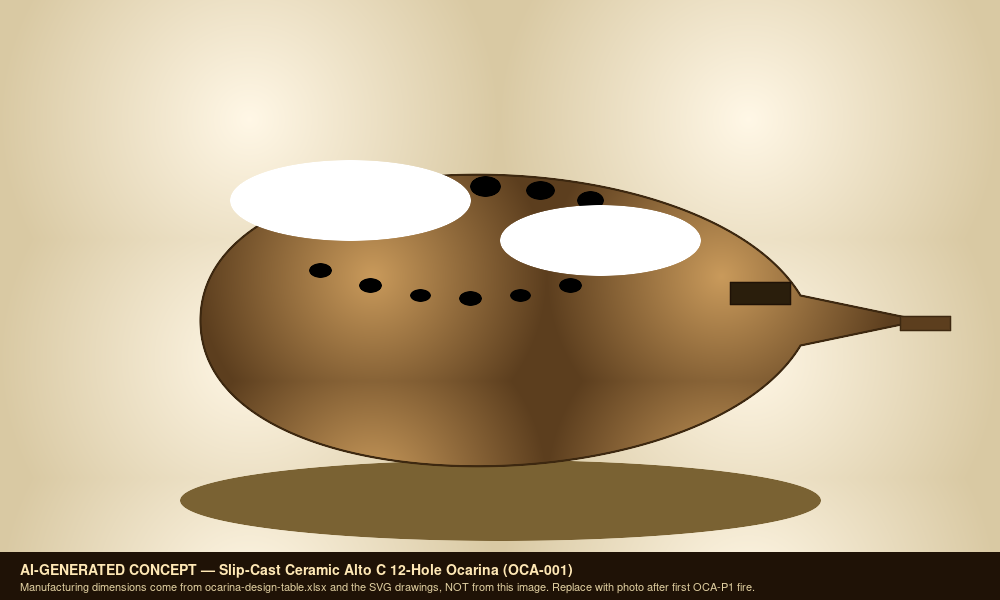
*AI-generated concept render — replace with photo of first OCA-P1 prototype after firing. Manufacturing dimensions come from the parametric design table, not from this image.*
Engineering documentation for a small family of slip-cast ceramic ocarinas, built around the Helmholtz vessel-resonator model and a 3D-printed-master / plaster-mold / Cone-6-stoneware production pipeline. The repository combines:
1. **A parametric design table** ([`ocarina-design-table.xlsx`](ocarina-design-table.xlsx)) — chamber volume, voicing-window geometry, wall thickness, shrinkage, and a 12-hole fingering chart with formula-driven hole-area / cumulative-area / frequency columns. Master scale factor `1/(1 - measured_shrinkage)` is parameterized; for a 12% shrinkage assumption, the master scales at ~1.136×.
2. **A full build packet** ([`design.md`](design.md), [`bom.csv`](bom.csv), [`sourcing.csv`](sourcing.csv), [`cut-list.csv`](cut-list.csv), [`validation.csv`](validation.csv), [`assembly-manual.md`](assembly-manual.md), [`supplier-rfq.md`](supplier-rfq.md), [`drawing-brief.md`](drawing-brief.md), [`visual-bom-brief.md`](visual-bom-brief.md), [`wolfram-starter.wl`](wolfram-starter.wl)) — the same scaffold used across the [`tonykoop`](https://github.com/tonykoop) musical-instrument catalogue.
3. **A capstone slide deck and printable shop packet** ([`capstone-deck.pptx`](capstone-deck.pptx), [`print-packet.pdf`](print-packet.pdf)) — recruiter-facing artifacts that show the design is documented well enough that someone else could build it.
Sister repos: [`gemshorn`](https://github.com/tonykoop/gemshorn) (where slip-cast horn-flute mold workflow was established and is the closest comparable build packet), [`transverse-flute`](https://github.com/tonykoop/transverse-flute) (slip-cast workflow at larger scale), [`flutes`](https://github.com/tonykoop/flutes) (the NAF / open-pipe family with empirical K2 bore corrections), and [`instrument-maker`](https://github.com/tonykoop/instrument-maker) (the agent skill that generated this packet).
The ocarina (Italian *little goose*) is a closed-cavity vessel flute. Unlike a transverse flute or a Native American style flute, **pitch is set by chamber volume and total open-hole area, not by tone-hole position along a bore**. The governing model is the Helmholtz resonator:
f = c/(2π) · √( A_open / (V_chamber · L_eff) )
where `A_open` is the cumulative open hole area, `V_chamber` is the closed cavity volume, and `L_eff = wall_thickness + 0.6·√(A_open/π)` is the effective neck length with a flanged-port end correction. The full physics treatment is in [`design.md`](design.md) (Governing Model section) and in [`wolfram-starter.wl`](wolfram-starter.wl).
The practical consequence is that ocarina hole positions are an **ergonomic** problem (where the fingers reach), not an acoustic one (where the standing wave wants the holes). This makes the ocarina an unusually clean parametric-design target — change the chamber volume, the whole register transposes; change the cumulative area, the fingering chart re-tunes — but it puts an unusually heavy burden on **fipple/voicing geometry**, which the Helmholtz model says nothing about and which has to be tuned empirically.
The first prototype is the magazine-standard **Alto C 12-hole** (target low note A4 = 440 Hz, target high note F6 ≈ 1397 Hz, chamber volume 130 cm³ per the design table). The same parametric model can drive a Soprano C / Bass C extension once the Alto C voicing geometry is stable — see the prototype ladder in [`design.md`](design.md).
| Prototype | Goal | Success criteria |
|---|
|---|---|---|
| **OCA-P0** voicing tile | Fipple-only practice cavity | Clear tone on a disposable test cavity |
|---|---|---|
| **OCA-P1** closed vessel | Verify chamber volume + fipple | Stable A4-ish all-closed tone before holes |
| **OCA-P2** 4-hole | Prove tuning workflow | Four tuned notes within ±25 ¢ post-bisque |
| **OCA-P3** 12-hole | Full range | Chromatic A4–A5 playable, no blocked grip |
| **OCA-P4** matched set | Soprano / Alto / Bass C | Shared mold logic, shared glaze family |
This repo is one of the **slip-casting targets** for the in-flight Bambu printer + kiln pipeline. The build chain is:
1. Parametric design table sets fired-body dimensions.
2. Master scale factor `1/(1 - measured_shrinkage)` scales the master STL.
3. Bambu print masters in PLA (or sealable resin); sand layer lines and seal.
4. Two-piece plaster mother mold around the sealed master.
5. Slip-cast Cone 6 stoneware → demold leather-hard → cut voicing window and finger holes undersized → bisque → tune → glaze → final fire.
6. Validate against [`validation.csv`](validation.csv); fold corrections back into the design table.
The same pipeline serves the [`udu`](https://github.com/tonykoop/udu), [`gemshorn`](https://github.com/tonykoop/gemshorn), and [`transverse-flute`](https://github.com/tonykoop/transverse-flute) repos.
ocarina/
├── README.md                       ← you are here
├── LICENSE                         ← CC-BY 4.0
│
├── design.md                       ← Helmholtz model, design intent, prototype ladder
├── ocarina-design-table.xlsx       ← parametric spreadsheet (formulas, blue inputs)
│
├── bom.csv                         ← bill of materials
├── sourcing.csv                    ← supplier/search tracker
├── cut-list.csv                    ← rough/finished dimensions, tolerances
├── validation.csv                  ← target/measured tuning + cents-error log
├── supplier-rfq.md                 ← RFQ template for slip / plaster / consumables
│
├── assembly-manual.md              ← shop-floor build sequence
├── drawing-brief.md                ← required views + critical dimensions for CAD
├── visual-bom-brief.md             ← visual-BOM art-direction brief
├── wolfram-starter.wl              ← Helmholtz physics starter notebook
│
├── capstone-deck.{md,pptx}         ← capstone slide deck (12 slides)
├── print-packet.{md,html,pdf}      ← combined print-ready shop packet (18 pp)
├── capstone-manifest.json          ← orientation manifest
│
├── cad/                            ← parametric body OpenSCAD starter
├── cnc/                            ← (deferred — slip-cast does not need CNC unless turning a wooden master)
├── drawings/                       ← SVG drawings: section, fipple detail, hole layout
└── images/                         ← AI-generated concept renders (placeholders)
| Section | Status |
|---|
|---|---|
| Parametric design table + Helmholtz model | ✓ done |
|---|---|
| Build packet (BOM / sourcing / cut-list / validation / RFQ) | ✓ done |
| Assembly manual + drawing brief | ✓ done |
| Wolfram physics starter | ✓ done |
| Capstone deck + print packet | ✓ done (auto-generated, recruiter-facing) |
| Concept renders (AI-generated, captioned) | ✓ done (placeholders) |
| Parametric CAD (OpenSCAD starter) | ✓ done (master-shape only; voicing detail by hand) |
| Dimensioned drawings (SVG) | ✓ done (section + hole layout) |
| Production-ready CAD (.step / .stl) | **deferred** — generated after empirical voicing validation in build queue |
| Mold turning / CNC toolpaths | **deferred** — slip-cast workflow uses 3D-printed master, not turned wooden master |
| First OCA-P1 prototype build | forthcoming (Bambu + kiln pipeline) |
Tier 3 production files (.step, validated .stl, .dxf for laser, .gcode for CNC) are **out of scope until the first OCA-P1 prototype validates voicing geometry**. See the README's status table and [`design.md`](design.md) "Open Assumptions" for the deferral reasoning.
Released under [CC-BY 4.0](LICENSE) — original written content, design files, photographs, and physics work in this repository are mine, free to reuse and adapt with credit.